
Microsoft Defender for Business: What You Need to Know
- Cyber Security
- M365


Microsoft 365 Intune is getting a serious upgrade in 2026, and this time it’s not just another paid add on. Microsoft has announced that several advanced Intune capabilities that used to sit in Intune Suite or separate licences will be included in Microsoft 365 E3 and E5.
For many organisations, that means more security and management features included in licences you already own, along with a price rise you will want to understand and plan for.
If you are not sure how this change affects your environment or your licence mix, our team can walk you through the options and help you avoid paying twice for overlapping tools.
Microsoft has announced that the following Intune capabilities will be included in Microsoft 365 plans in 2026:
These have previously been part of Intune Suite or separate add-ons, which meant extra monthly cost and more complexity when you were trying to build a complete device management and security stack.
At the same time, Microsoft has flagged Microsoft 365 price increases from 2026, with more details to come closer to the date.
In short: more value in E3 and E5, but you need to keep a closer eye on overlap, costs and deployment plans.
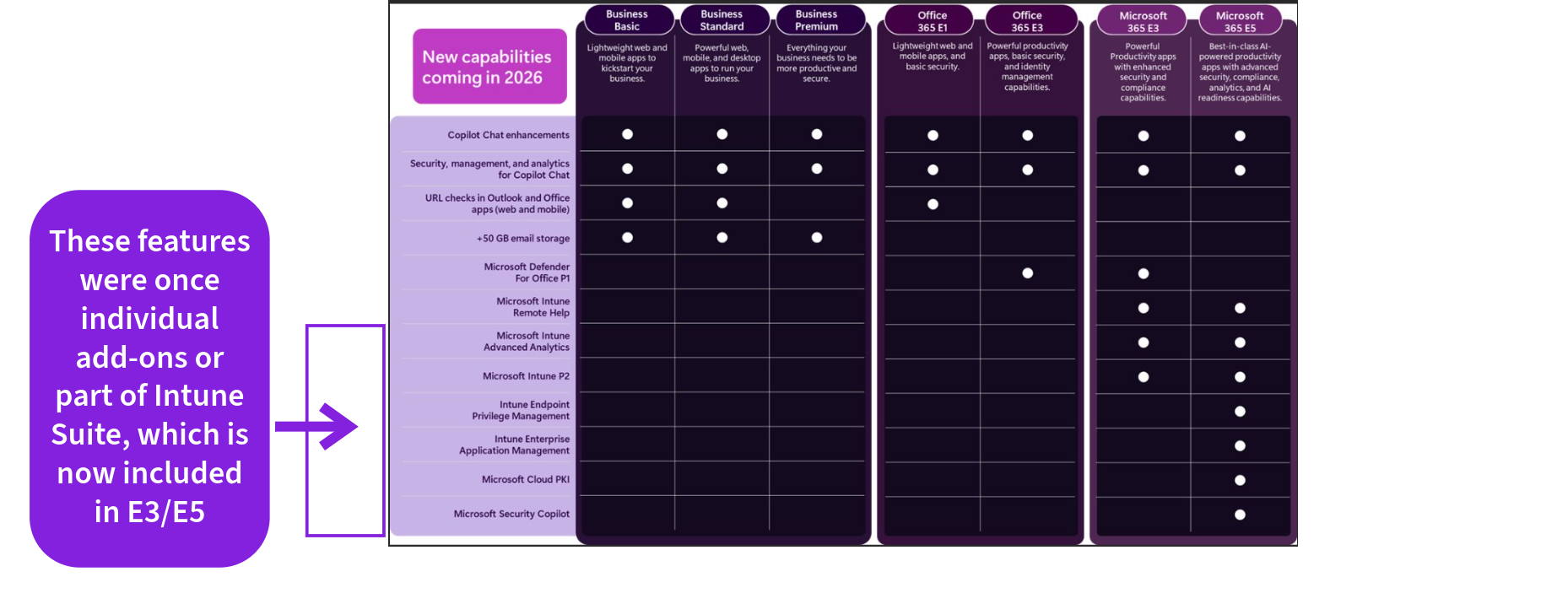
Here is what each of the new Intune capabilities actually gives you in practice.
Cloud PKI gives you a cloud hosted public key infrastructure so you do not need to maintain your own certificate services on premises.
That means:
If you already pay for Cloud PKI as an add on, this change may create room to reduce cost once Microsoft confirms the final licensing model.
Endpoint Privilege Management lets you control local admin rights at a much more granular level. Instead of giving users full admin or removing it completely, you can:
If you are using a third party tool for elevation control and already have Microsoft 365 E5, this could replace that product for cost sensitive customers.
Intune Advanced Analytics is all about better visibility and decision making. It gives you:
For larger fleets this can make it easier to roll out changes at scale with confidence instead of guessing based on a few sampled machines.
This is Microsoft’s answer to the pain of third party application management and patching.
The intent is to:
It is still maturing, but over time this should speed up Intune deployments and make third party patching simpler and more consistent.
Security Copilot brings Microsoft’s AI driven threat analysis and response into your existing security stack.
For IT and security teams, this means:
It is designed to help teams close the skills and capacity gap, not replace traditional tooling. Including it in E3 and E5 drastically increases its reach.
Intune Plan 2 adds several advanced endpoint management capabilities that previously required additional licensing, including:
Bundling this into E3/E5 makes the baseline Intune experience significantly more complete and reduces the gap between core and premium endpoint management.
These Intune changes will have a few ripple effects on licensing.
Some key points to think about:
This is the right time to map what you are actually using, check usage against licences and make sure you are not carrying shelfware.
For most customers, these changes are good news, but only if you actually use the new features you are paying for.
Some practical next steps:
If you already work with us, we will be recommending which features to prioritise in your specific environment and how to line them up with other projects like Windows 11 uplift or security hardening.
Changes like this are where a bit of planning goes a long way. You do not want to rush into ripping out existing tools, but you also do not want to pay for duplicate capability for years.
We can help you:
If you would like to talk through what the new Microsoft 365 Intune changes mean for your organisation, get in touch with our team and we can walk you through it.




Got questions, ideas, or just want to chat? We'd love to hear from you! Reach out to us anytime, and we'll get back to you with all the help and information you need.


